Solo was already part of the picture.
The portable system shows another side of infrared: it didn't have to mean a permanent cabin or a spa appointment.
 Living Through
MY SUNLIGHTEN STORY / 2017–TODAY
I worked for Sunlighten. I had a hand in improving parts of the technology and digital/customer experience. I also used the saunas myself—often—while living with CRPS.
For me, it helped. A lot.
I no longer work for the company. That doesn't change what the people, the technology, or those years meant to me.
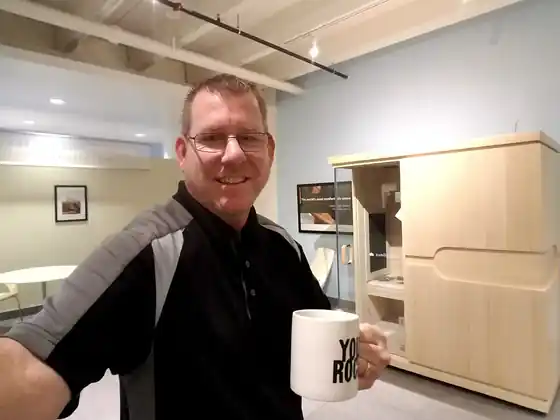
I previously worked for Sunlighten, had unusual access to its products, and Sunlighten's owners provided my Solo System. I do not work there now, this site is independent, and I am not an affiliate. What follows is my lived experience and my archive—not a paid endorsement.
01 / THE PHOTOGRAPHS
I have a lot of photos from this chapter of my life. Together they show something that is hard to explain with a product description: infrared was woven into ordinary days. Sometimes it was a deliberate session. Sometimes it was fifteen minutes between meetings. Sometimes it was the Solo waiting at home.
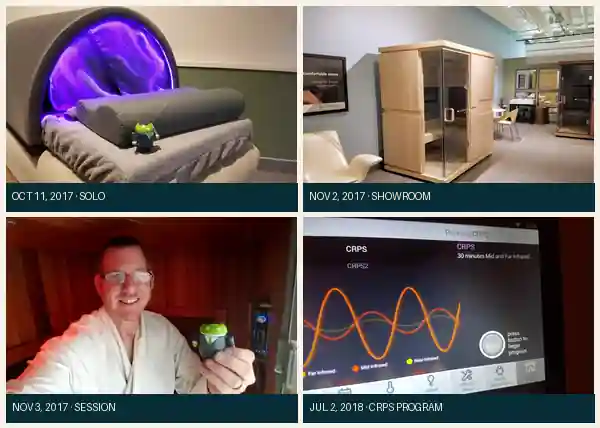
The portable system shows another side of infrared: it didn't have to mean a permanent cabin or a spa appointment.
I would step into the demo saunas for quick sessions—sometimes around fifteen minutes—then go back to work.
My relationship with the technology wasn't theoretical. I was inside the saunas, experimenting with what felt useful in real life.
The screen in my archive reads “CRPS — 30 minutes Mid and Far Infrared.” It documents the program I was using at the time.
02 / ON THE CLOCK
One of my favorite things about working at Sunlighten was simple: the saunas were right there. I could walk into a demonstration unit fully dressed, turn the heat down, sit for a short recharge, and get back to my desk.
Those sessions weren't always about chasing the hottest possible temperature or turning the day into a wellness ritual. I was trying to function. I was trying to keep working. And for me, warmth could make a difficult day feel more manageable.
That ordinary use is important to this story. Infrared wasn't a once-a-month appointment. It became part of the environment around me.
03 / THE mPULSE YEARS
My old dashboard photograph captures the mPulse interface running a CRPS program. The screen says “30 minutes Mid and Far Infrared.” That image is one of the clearest pieces of contemporaneous evidence in my archive because it shows what I was actually using rather than what I remember years later.
I also used mPulse sessions at the Sunlighten Day Spa. My earlier published account described going roughly three times a week during that period, often combining the session with breathing, meditation music, and gentle stretching.
And yes: I felt the sessions helped my pain. I don't need to water that down. They worked well for me.
Of the cabins I came to know during those years, mPulse remains my personal favorite. That is a memory and a preference, not a claim that one model is better for everyone.
What the dashboard proves is that the program existed and that I used it. My personal response is my experience. Whether a specific infrared protocol is an established treatment for CRPS is a separate research question, which is why the Pain Lab keeps the science next door instead of pretending the two are identical.
04 / AT HOME
The Solo System gave me a different kind of access. I could use infrared at home, especially when cold weather or a bad pain day made the idea of going somewhere feel like too much.
That mattered during Kansas City winters. Sometimes what I wanted most was the feeling I described years ago as a huge hug: warmth around a nervous system that did not always know how to turn the volume down.
I still have the Solo. It remains part of the toolbox I can reach for on difficult days.
05 / I WASN'T ONLY A CUSTOMER
My Sunlighten chapter is unusual because my personal and professional histories overlap. I worked there from 2017 to 2020, around the products and the people every day, and I had a hand in improving parts of the technology and the digital/customer experience.
That access made me more curious, not less. I could see the hardware, the software, the programs, the questions customers asked, and the way the technology kept evolving. It is one reason this section of Living Through the Pain now goes far deeper than a testimonial page.
We can trace old controls to newer connected-sauna ideas, compare heater technology, read patents, inspect current specifications, and then put all of that beside the human question I started with: what actually helped me live?
06 / WHY I STILL TALK ABOUT SUNLIGHTEN
I can still call Sunlighten an amazing company even though I no longer work there. Leaving a job doesn't erase the people you respected, the things you helped build, or what a technology meant in your own life.
For me, infrared became one of the meaningful tools in a much bigger recovery story. It existed alongside movement, rehabilitation, other therapies, changes in medication, sleep, pacing, time, and a stubborn desire to keep living.
“We're not building a website about a disease. We're building a website about a life that refuses to be defined by one.”
Sunlighten belongs in that life story.
THE PUBLIC ARCHIVE / WATCH THE STORY
The older video is part of the public record of what I reported at the time. From there, you can keep digging into the current technology and research.
PERSONAL STORY / 2019-era source
A personal account of living with CRPS and using infrared sauna. Not a clinical demonstration of treatment effectiveness.
Watch directly on YouTube ↗Editorial update: November 2026. Historical dates attached to the photographs are filename-derived where EXIF was unavailable. This page is first-person history; current product details are maintained separately in the Sunlighten research library.